New or Used Pallet Rack: How to Decide for Your Warehouse
There's no single right answer, but there is a right answer for your building, and a few plain questions will find it.
October 16, 2026 · 4 min read
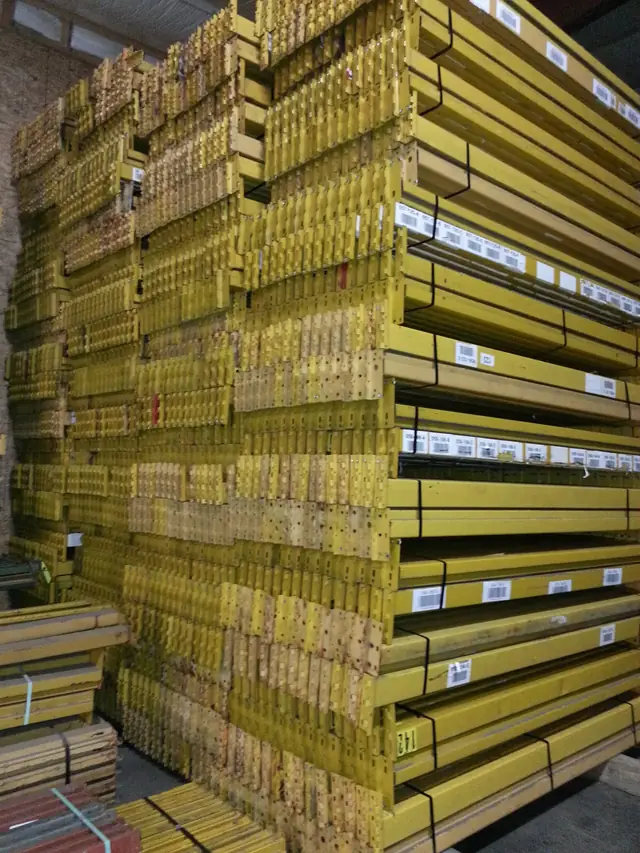
Almost everyone who calls about pallet rack asks the same thing first: should it be new or used? The honest answer is that it depends, and it depends on things you already know about your operation. Once you put those things into words, the choice usually makes itself.
Start with what the rack has to do
Pallet rack is steel that holds product off the floor. So the job matters more than the age of the steel. How heavy are your heaviest pallets? How many levels do you need? Do forklifts clip the front uprights every week, or is this a quiet back room where one pallet moves an hour?
A run of rack holding slow-moving stock in a corner asks very little of itself. A run at a dock door, loaded and unloaded all day, asks a lot. Write those answers down before you compare anything, because they tell you how much margin you want. Margin is where new rack earns its keep.
Where used rack makes sense
Used is the usual answer when the budget is tight or the deadline is close. Used heavy duty rack is the same basic hardware as new: uprights, beams, wire decks, row spacers, pallet supports. If the pieces are straight, undamaged and compatible with each other, they do the same work.
- You need a lot of pallet positions in a fairly standard layout.
- You're adding onto an existing run and the new pieces have to match what's already standing.
- The product is lighter or slower-moving, so wear matters less.
- You need it soon. Stock that's already sitting in a yard can usually move faster than something built to order.
Material Handling Solutions evaluates its used equipment and prices it according to condition. They also encourage pre-shipment inspections, so you can see the pieces before they're loaded. Take them up on that. Used lots can vary from one piece to the next, and a look beforehand costs you an hour, not a surprise on the dock.
Where new rack makes sense
New is the better call when the details are fixed and there's no room to compromise. Maybe you need an exact depth or beam length that matches your pallets. Maybe the rack will carry heavy loads for decades and you want to know the steel has never been hit, overloaded or rearranged. Maybe you simply want one uniform finish across a whole building.
New is also the route for things that are designed around your space rather than pulled from inventory, like mezzanines and in-plant offices. Those are built to fit, so there isn't really a used version to compare.
The matching problem
Here's the trap people fall into. Rack from different manufacturers doesn't always connect. The beam end has to lock into the upright's slots, and slot styles differ. A beam that looks right can still sit loose or refuse to seat. If you're mixing used and new, or adding to an old run, say so up front and bring the details of what's already installed, including photos of the upright face and the beam connector.
The same goes for depth and height. Standard heavy duty uprights come in a range of heights and in depths like 36, 42, 44 and 48 inches, and beams run from 92 to 144 inches long. Your pallet dimensions drive which combination makes sense. Guessing is how people end up with beams that are a few inches too short.
Layout matters more than age
A well-planned layout in used rack will beat a sloppy layout in brand new rack almost every time. MHS prices racking by the layout, which is a clue about how they think. They'll work with you on the plan and can fabricate uprights to fit the building, which helps when your ceiling or column spacing doesn't cooperate with standard sizes.
If you can sketch your floor, mark the doors and columns, and note your ceiling height, you're most of the way to a useful conversation. That sketch matters more to a good quote than a decision about new versus used, and you can decide the second thing after seeing the first.
A quick way to settle it
- If the load is heavy, the traffic is rough and the rack has to last, lean new.
- If you're matching an existing system, ask what's compatible before you assume either way.
- If you're short on money or time and the use is moderate, lean used and ask for an inspection.
- If you can't decide, a mix often works: new where the abuse is worst, used where it isn't.
Whatever you pick, the people selling it should be willing to answer your questions plainly. Brian Woods has spent more than thirty years in industrial engineering and sales, and the team here sees projects through from the first quote to the last beam. You can call them at (317) 755-2219 with your sketch, or look at the used pallet rack page at /services/used-pallet-rack and the new equipment page at /services/new-equipment to see what's available.
Material Handling Solutions, (317) 755-2219
Call (317) 755-2219More articles
What to Measure Before You Ask for a Pallet Rack Quote
Ten minutes with a tape measure and a forklift spec sheet will save you days of back and forth.
What to Check on Used Uprights and Beams Before They Ship
A pre-shipment look at used rack is the cheapest insurance you'll buy this year, as long as you know what to look for.